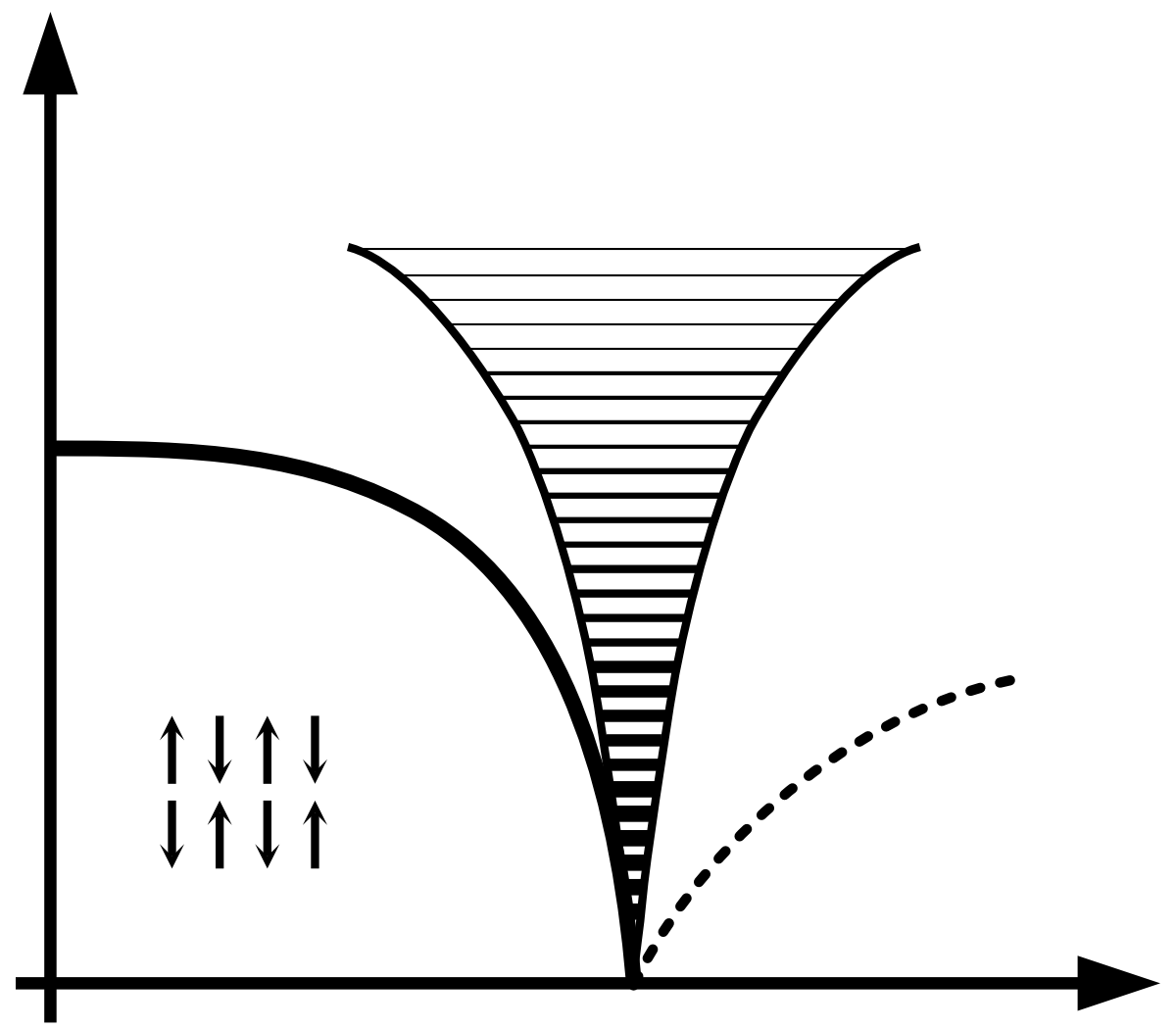
First, we need to understand what causes electrical resistance in a pure metal. Then we will see what happens when magnetic impurities are added.
The fact that electrons interact only weakly with each other, and can essentially be treated as a gas of free fermions, allows electrical transport in a metal to be described using a Boltzmann transport theory, in which the resistivity is determined by various scattering processes.
At very low temperatures, scattering off impurities or imperfections in the lattice dominates, limiting the electrical transport to a fixed residual value.
As the temperature is raised, the ions in the lattice begin to move away from their ideal positions, which breaks the translational invariance of the crystal. These lattice vibrations are known as phonons, and they provide an additional scattering channel for the electrons.
This behaviour is captured by the Bloch–Grüneisen formula, which introduces a characteristic temperature — the Debye temperature θD — as a measure of the stiffness of the lattice vibrations. Well above θD, the electrical resistivity ρ varies linearly with temperature. Well below θD, it follows a T5 dependence, before eventually saturating at a residual value ρ0 at zero temperature, set by the average spacing between impurities.
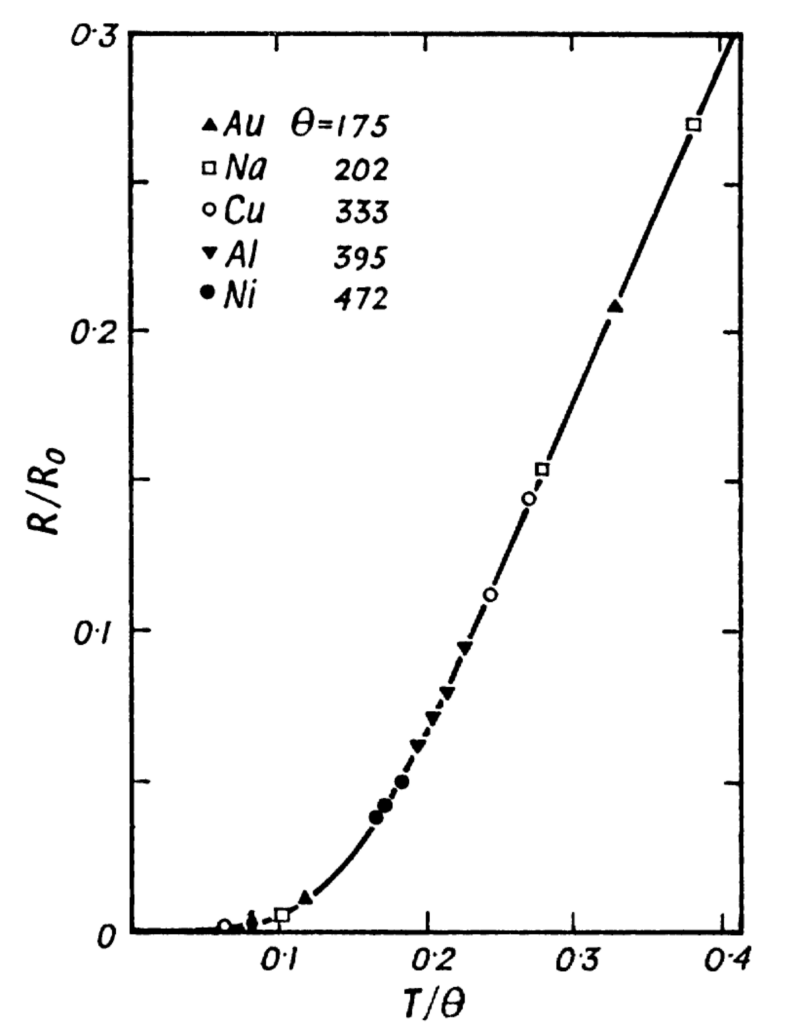
Strikingly, when the resistivity of different metals is plotted as a function of the rescaled temperature T/θ<sub>D</sub>, they all collapse onto a common curve.
Relatively early on, researchers noticed that adding magnetic impurities to an otherwise non-magnetic metal disrupts this clean picture. Instead of saturating at low temperatures, the electrical resistivity passes through a minimum and then starts to increase logarithmically with decreasing temperature.
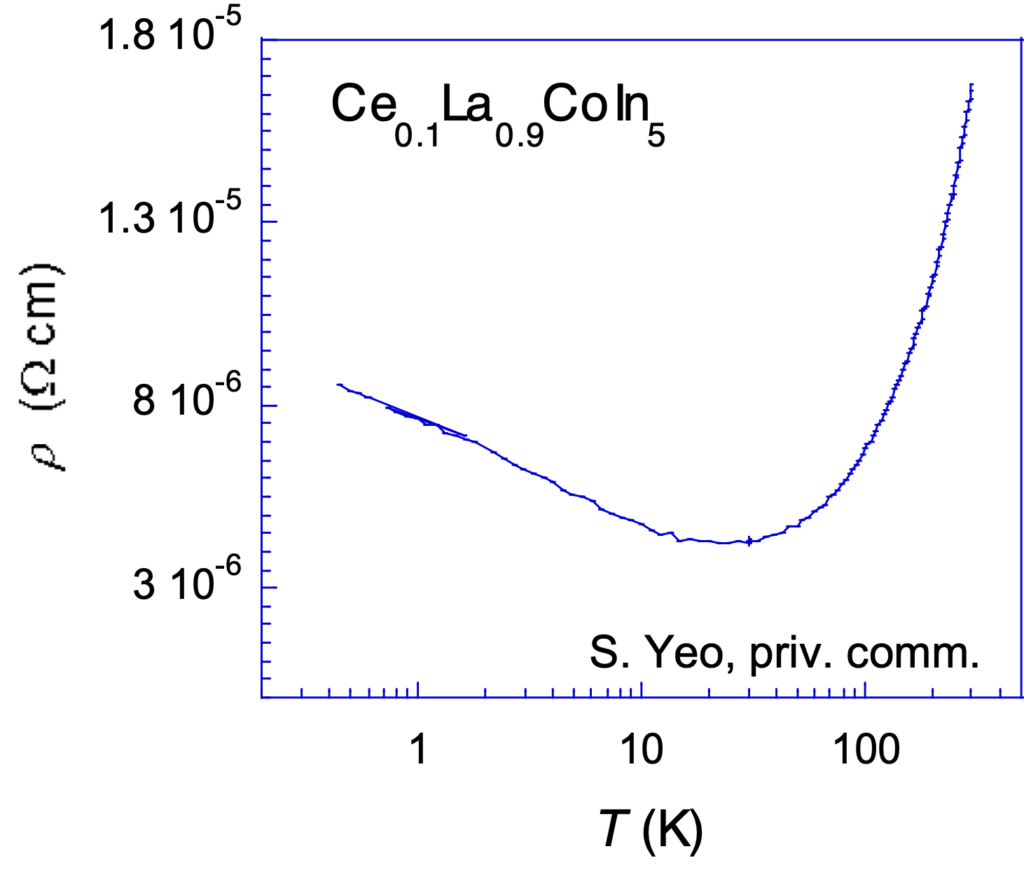
A concrete example is LaCoIn5, a good non-magnetic metal. When 10% of the La is replaced by magnetic Ce, cooling from high temperature reveals a resistivity minimum at around 40 K, below which the resistivity increases logarithmically. On a semi-logarithmic temperature scale, this produces a characteristic straight-line upturn toward the lowest temperatures.
The conduction electrons are scattering off the magnetic Ce atoms, giving rise to what is known as the Kondo minimum in the resistivity and a logarithmic divergence at the lowest temperatures.
This was the first hint of what was to come. Next, we look at what happens when the magnetic atoms are no longer isolated impurities but are arranged into a lattice.
If you wish to contribute to this text, please feel free to email an improved version to Andrea Bianchi.