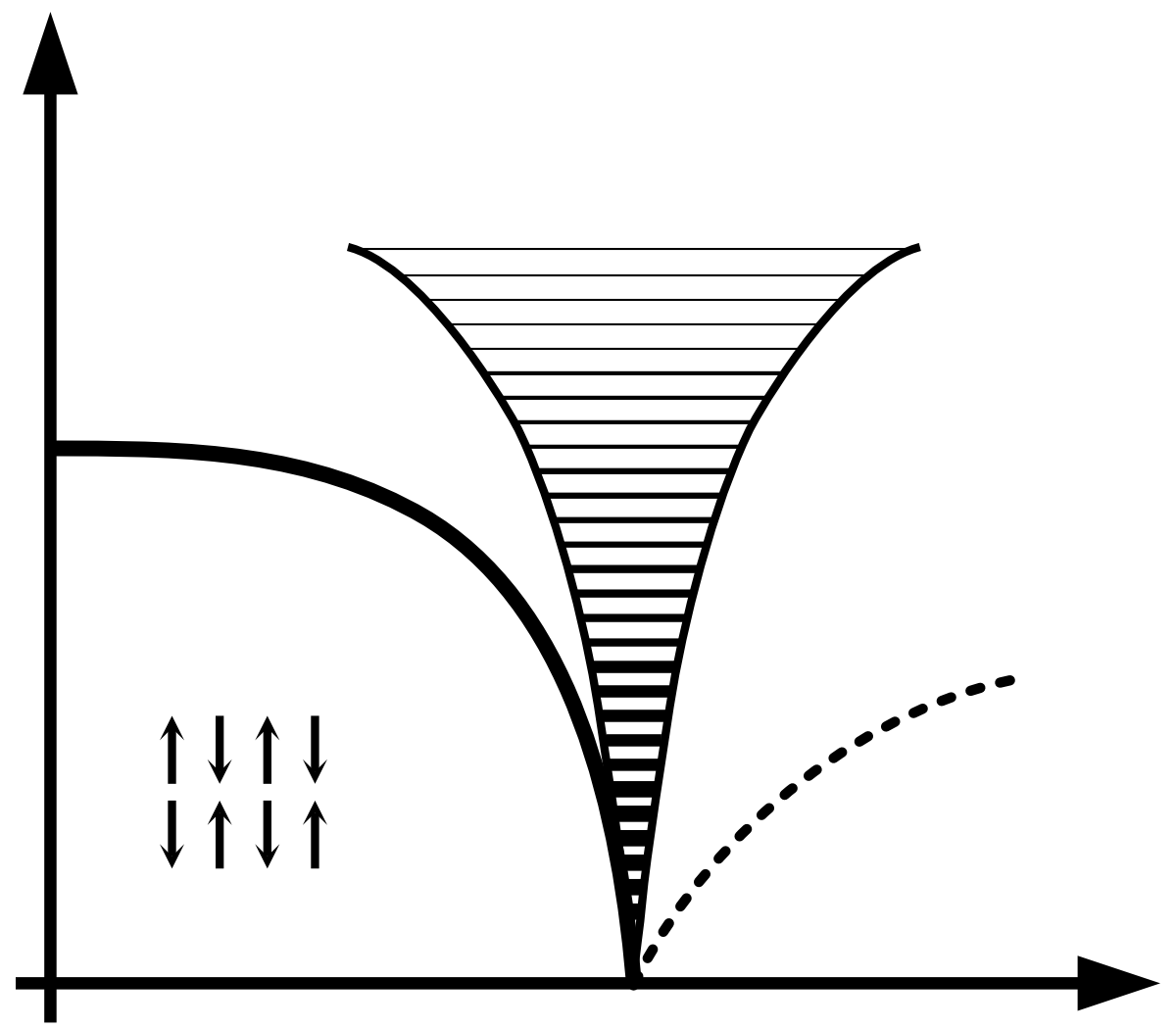
Strongly correlated electron systems (SCES) are materials in which the interactions between electrons are strong — which is, admittedly, something of a pleonasm.
SCES covers many aspects of condensed matter physics, the branch of physics dealing with fundamental properties of matter as they manifest in solids, liquids, and gases. This broader scope is part of why Nobel Prize winner Phil Anderson championed the term condensed matter physics over older ones like solid state physics.
Physics is often accused of being reductionist — reducing everything down to its smallest components. Condensed matter physics sets itself apart by dealing with ensembles of particles, which gives rise to emergent behaviour that simply cannot be observed in a single electron.
Take magnetism as an example: one isolated spin cannot produce magnetic order. It won’t give you ferromagnetism — the phenomenon behind the magnets holding your photos to the fridge. For that, you need cooperative phenomena such as phase transitions. The onset of ferromagnetism, for instance, causes the many spins in a magnet to align in the same direction, producing a net magnetization that lets it stick to the steel of your refrigerator door. Anderson captured this idea memorably by noting that “more is different”.
To build up some understanding of what SCES actually is, we start with (nearly) free electron materials and work our way up, trying to give a flavour of the interesting discoveries made along the way. The list below mixes chronological order with what makes the story easier to tell:
- Free electrons: what happens when interactions between electrons are weak
- Kondo effect: a first glimpse of things to come — what happens when magnetic impurities are added to an otherwise good non-magnetic metal
- Heavy Fermions: instead of dilute impurities, the magnetic elements now form a lattice
- Heavy Fermion superconductivity: when superconductivity turns magnetic
- Quantum Critical Points: what happens when a phase transition is suppressed to zero temperature
- High-Tₐ superconductors: are they even metals, and what about magnetic fluctuations?
- Quantum spin liquids: can we find an entangled ground state?
- Topological insulators et al.: there are more phases of matter than just insulators and metals