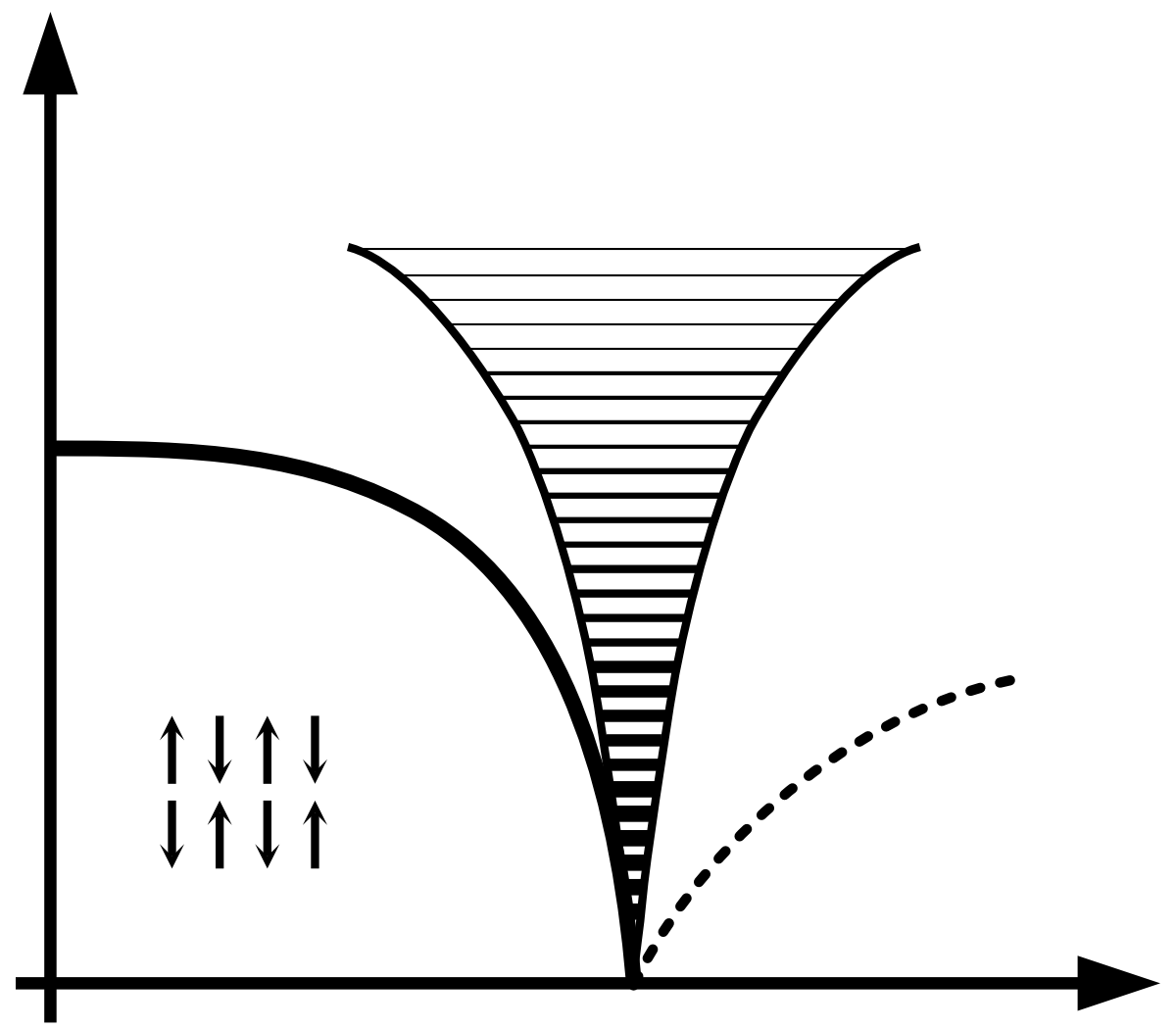
We start by looking at the electrons in a periodic arrangement of atoms in a solid. The fact that atoms are placed in a repeating periodic structure — a crystal — has a profound impact on their quantum mechanical states.
In a metal (say, sodium, Na) or an insulator (say, silicon, Si), the electrons interact only weakly with each other. This is due to the periodic arrangement of atoms inside the crystal. A so-called metallic bond is formed, in which the atoms release all the electrons from their outermost shell into the conduction or valence band, leaving behind positively charged ions sitting at the lattice sites.
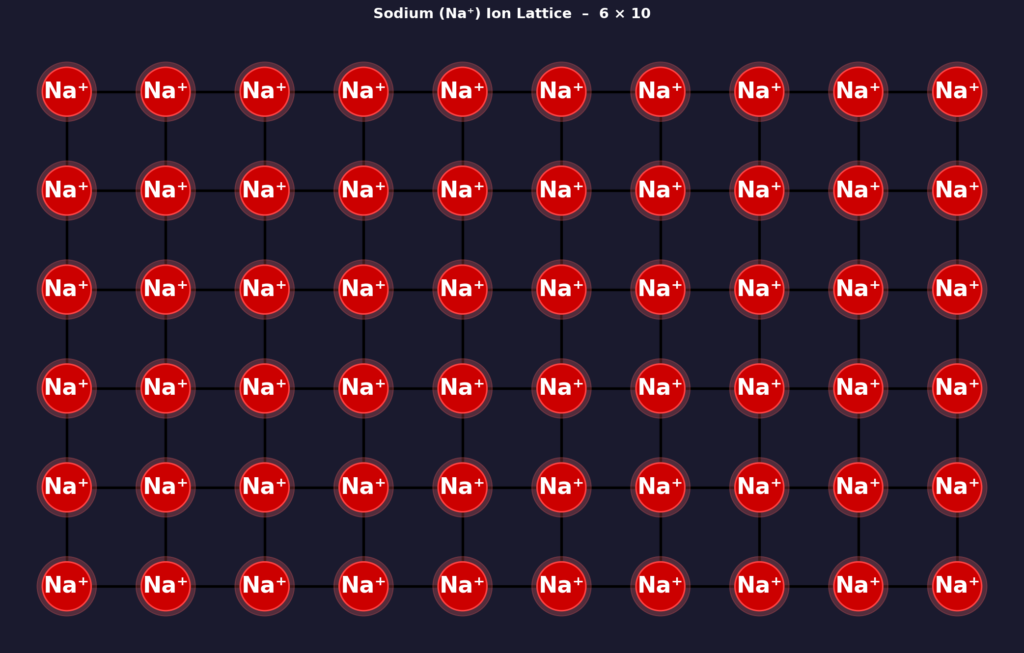
This insight goes back to Felix Bloch, who eventually received a Nobel Prize for it. The periodicity — the fact that the same motif repeats throughout the crystal — leads to the surprising result that electrons behave as if they were a quantum gas of free Fermions: particles carrying a charge of −e and a spin of 1/2, subject to the Pauli exclusion principle.
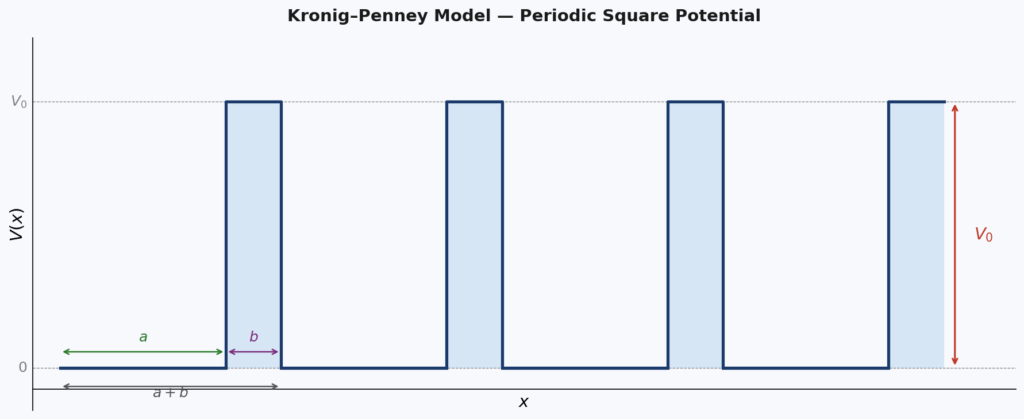
A good way to build intuition for this is to look at a toy model: a single free electron placed in a one-dimensional square array of potentials. This is the so-called Kronig–Penney model.
Solving this model shows that the good quantum number is the wave vector k of the electron, which replaces the familiar s, p, d, f, … atomic shell quantum numbers of an isolated atom. A notable feature is that there are regions in energy — the so-called band gaps — for which no solutions exist. In between, there are continuous ranges of energy, the bands, for which solutions do exist, shown as the coloured bands in the diagram.
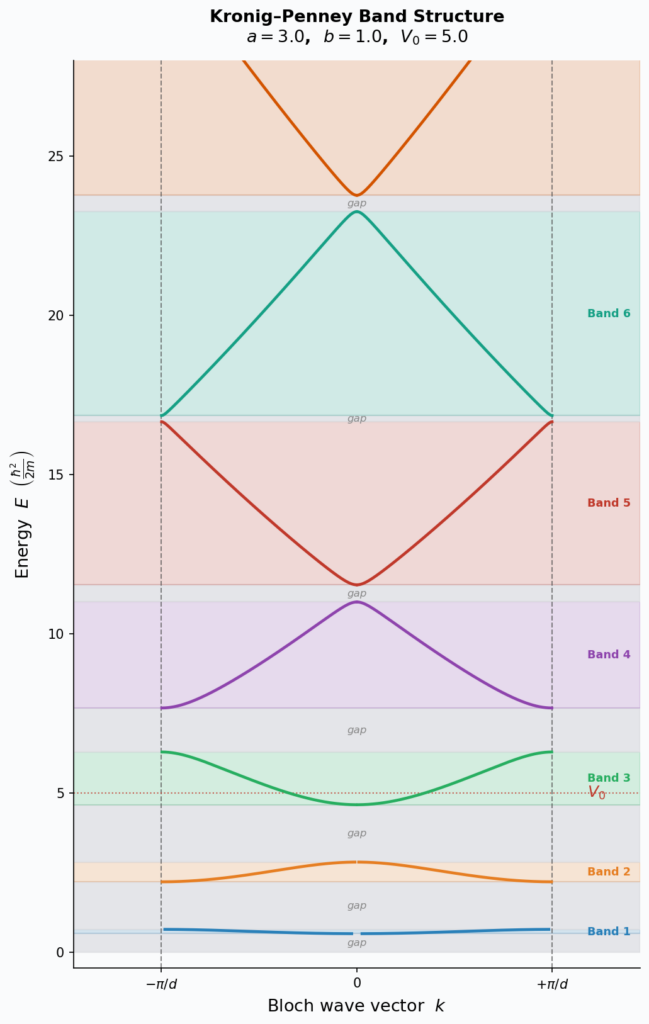
Now one has to fill all the electrons of the crystal into the band structure. Since electrons are Fermions, only one electron per spin direction is allowed at each energy level. If the last electron sits at an energy inside a band, the material is a metal — there are nearby empty states into which electrons can be nudged by a small voltage from a battery, giving rise to electrical conduction, as in Na. If the last electron exactly fills a band, the material is an insulator. In that case, a small nudge is not enough, since the next available (unfilled) state is separated by a gap. This gap is large in a good insulator like SiO₂, and somewhat smaller in a semiconductor like Si — which is essentially an insulator with a modest band gap. At room temperature, only a few charge carriers are thermally excited across it, making it difficult to pass a current.
The concept of band structure underpins the first revolution in quantum materials: through semiconductor technology, it gave us semiconductor power electronics — those little square bricks that charge your phone — and of course the modern computer, via the transistor.
In the next section, we will look at what happens to the electrical transport of a metal when magnetic impurities are introduced, which leads to the Kondo effect.
If you wish to contribute to this text, please feel free to email an improved version to Andrea Bianchi.