First we have to explain why superconductivity in Heavy Fermions is unconventional and was not at all expected at the time. For this lets begin by looking at conventional superconductivity, which has been explained by the microscopic BCS theory. In this theory, the formation of Cooper pairs is essential. In the simplest case, for a normal metallic superconductor, the conduction electrons “talk” to each other via the vibrations of the lattice, the phonons, and they form, in the simplest case, singlet pairs of electrons:
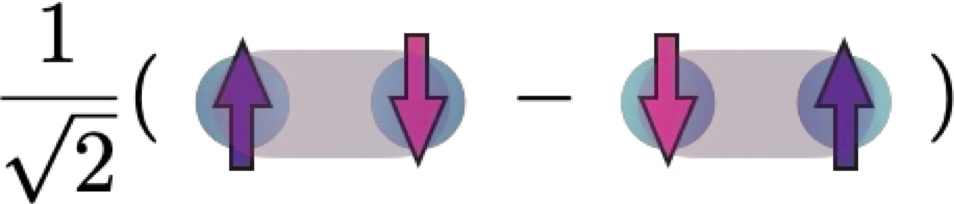
A singlet pair of electrons is a quantum mechanical superposition of a pair of two electrons with a particular orientation of their spins, up-down – down-up, which carries no magnetic moment.
Now in a heavy fermion, there are all these magnetic moments as they are built from 4f and 5f elements. Now when a Cooper pair collides with such a magnetic moment which carries a large spin, one of the spins in the singlet pair is flipped, which destroys the singlet.
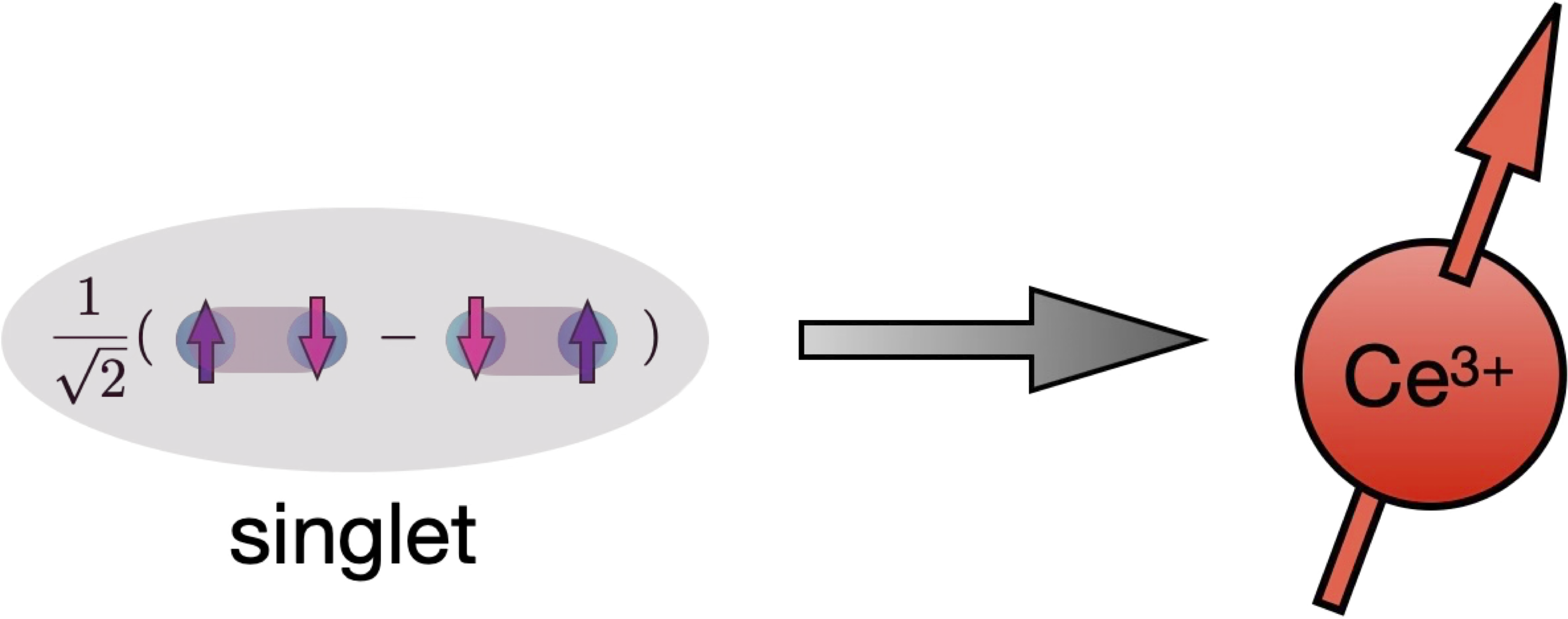
This was theoretically predicted by Abrikosov and Gor’kov (A. A. Abrikosov and L. P. Gor’kov, Sov. Phys. JETP 12, 1243 (1961), you have to go to an actual library and get yourself a paper copy!), and soon thereafter experimentally verified in Gd doped LaAl2 by Maple. LaAl2 is a non-magnetic metallic superconductor and the addition of only a few percent of Gd which carries a large magnetic moment is sufficient to suppress superconductivity. Thus, no one really expected to find superconductivity in heavy fermion compounds, as they have a lattice filled with magnetic 4f or 5f elements.