The next chapter in the story of SCES opened with the discovery of CeAl3 by Andres, Ott, and Graebner, which showed an unusually large electronic contribution to the specific heat — in fact, over 1000 times larger than what one would expect in a normal, uncorrelated metal. It is also worth noting that the linear contribution to the electronic specific heat is proportional to the effective mass of the electrons in a normal metal, where the electrons are treated as free electron gas. This would suggest that the conduction electrons in CeAl3 acquire a much larger mass through their interactions, lending the name “heavy fermions” to this class of materials.
Let us briefly switch from CeAl3 to CeCoIn5 to illustrate the difference between non-magnetic f element and a magnetic f element. We can look at a crystal structure, which can be made with both non-magnetic Lanthanum and magnetic Cerium: LaCoIn5 contains a non-magnetic La3+ ion, whereas in CeCoIn5 the Ce3+ ion carries a magnetic moment.
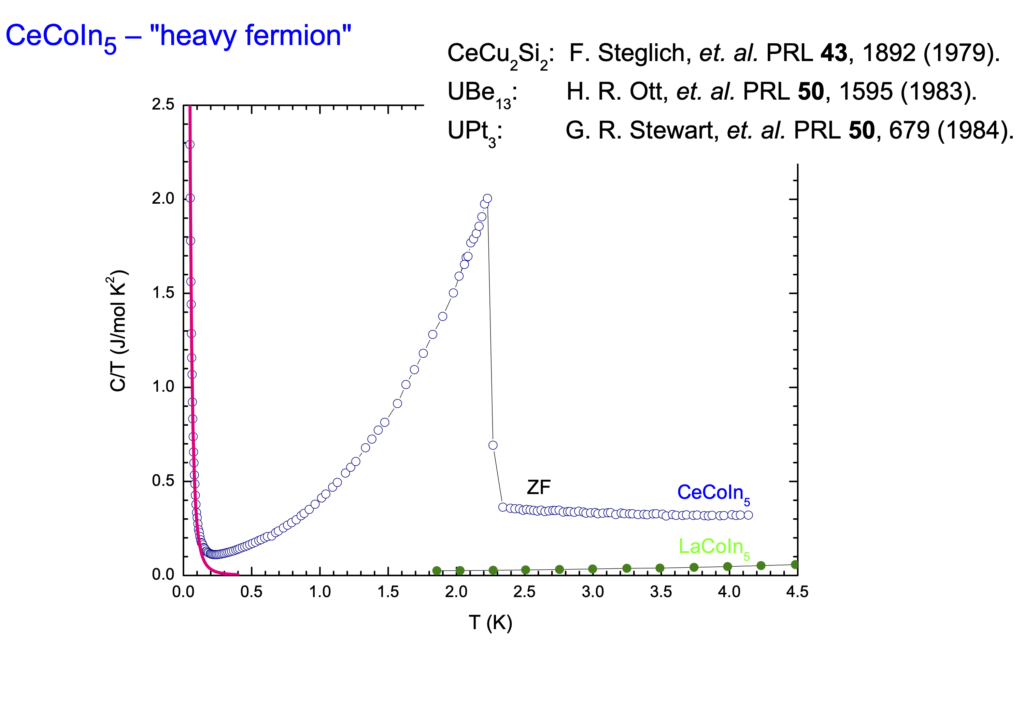
This figure shows the electronic specific heat of CeCoIn5, a heavy fermion, and LaCoIn5, a normal metal, at temperatures below 5 K, plotted as C/T vs. T. This type of plot highlights the linear, i.e. electronic, contribution to the specific heat. The values for CeCoIn5 above 2.5 K are much larger than those for the non-magnetic LaCoIn5, as if the addition of magnetic moments on the 4f element cerium leads to a strong enhancement of the specific heat.
That it is truly the electrons that are becoming “heavy” in these compounds can be demonstrated experimentally by measuring the thermal conductivity and checking the validity of the Wiedemann–Franz law:
In a metal such as CeAl3, electrons carry not only electrical current but also heat. Most cooking pots have stainless steel handles because stainless steel is a poor electrical conductor — so the handle stays cool. If it were made of a good conductor like copper, the heat from the hotplate would travel straight to your hand. Should the conduction electron in a heavy fermion compound truly become “heavy” this should also be reflected in their thermal conductivity.
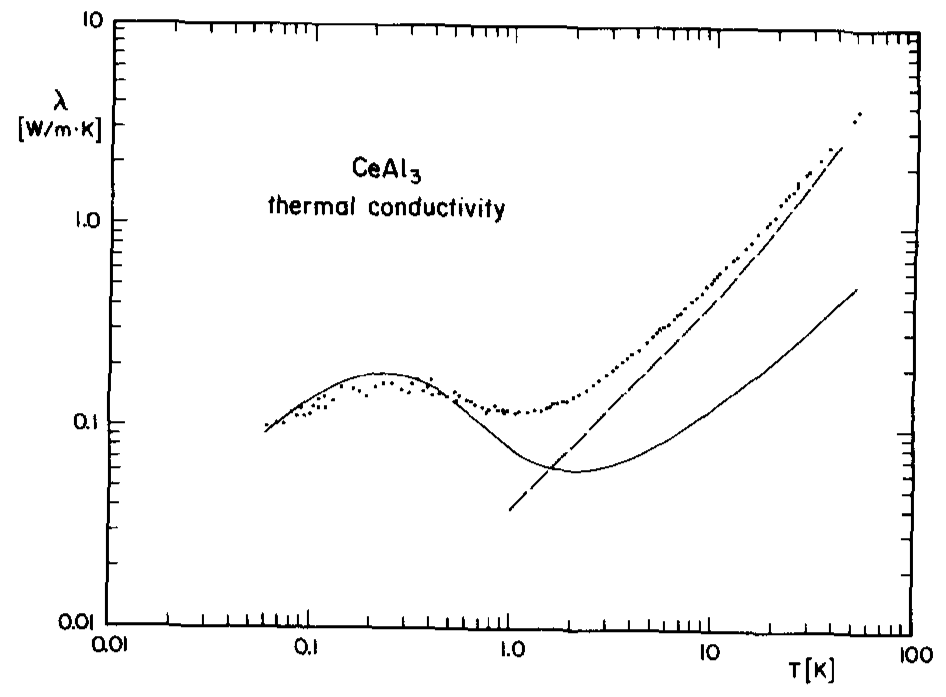
The figure above shows the low-temperature thermal conductivity of CeAl3 on a double-logarithmic scale, illustrating the Wiedemann–Franz law. The thermal conductivity carried by the conduction electrons is compared to what one would estimate from the electrical resistivity alone. Below 1 K, the two agree well: the experimental thermal conductivity data (filled circles) match closely the estimate obtained from the electrical conductivity via the Wiedemann–Franz law.
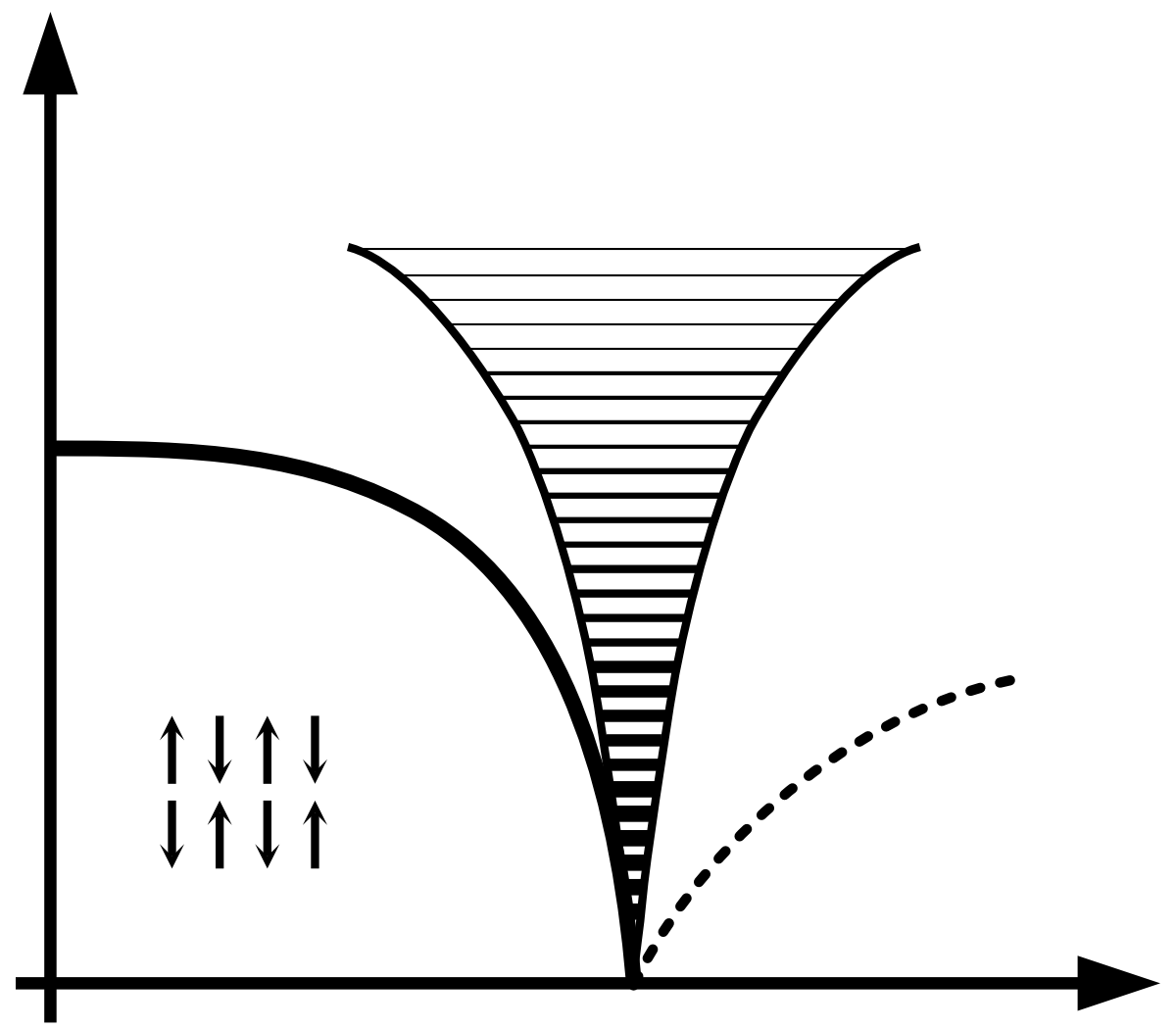
There is another curious feature. The magnetic susceptibility in heavy fermion compounds follows a Curie–Weiss law, indicating that the Ce3+ ions carry a magnetic moment and that these moments interact antiferromagnetically. Under normal circumstances one would expect such a material to undergo an antiferromagnetic phase transition at low temperatures, with the moments settling into some up-down-up-down pattern. Curiously, this does not happen. Instead of a phase transition, the magnetic susceptibility flattens off and becomes constant at the lowest temperatures — at values far larger than the Pauli paramagnetic susceptibility of a normal metal. These materials thus seem to teeter between being truly magnetic and being non-magnetic, all while being strongly correlated.
This dual nature of the Ce3+ magnetic moments in CeAl3, CeCoIn5, and other heavy fermion compounds is at the heart of the strong correlations. It can be understood from the character of the underlying wave functions: the 4f orbitals of cerium (or the 5f orbitals in uranium compounds) are of mixed character, intermediate between being localised on the f atom and fully delocalised into the conduction band.
In heavy fermion compounds, the f elements form part of the periodic crystal lattice. Rather than acting as isolated Kondo centres as in the Kondo effect, they form strongly correlated bands, giving rise to a host of unusual properties — the most spectacular, and not at all expected, which is superconductivity, discussed on the next page.
If you wish to contribute to this text, please feel free to email an improved version to Andrea Bianchi.