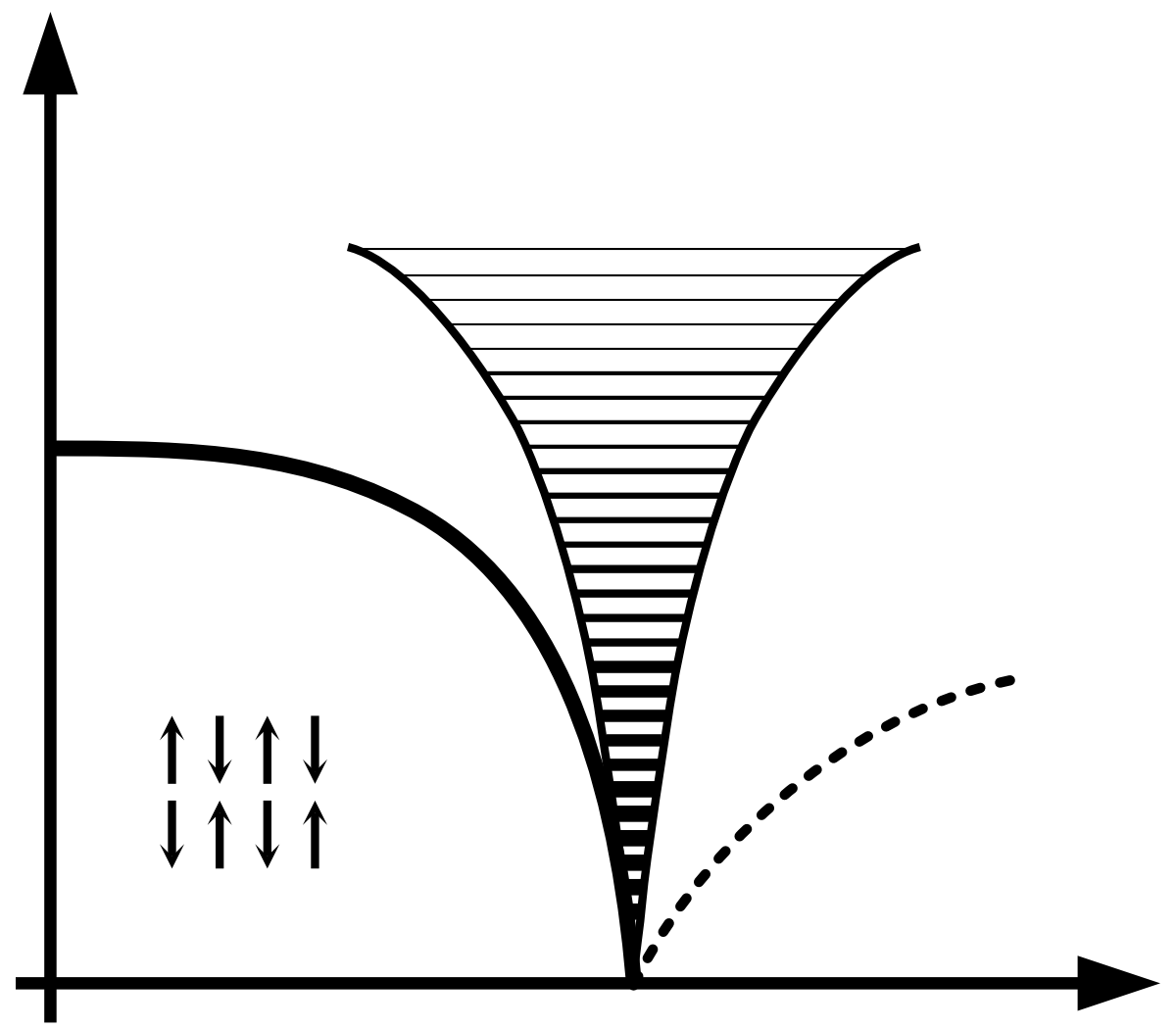
The high temperatures superconductors, or cuprates, as much as exploded onto the scene with the discovery of superconductivity in BaxLa1-xCu5O5(3-y) by Bednorz and Müller in 1986. This discovery promptly earned them the Nobel prize in 1987. Here, as you can note from the subscripts of in the chemical formula of this compound, some of the elements have been replaced (x: La by Ba) and the oxygen content y is not stoichiometric either. This will be important in what follows.
Not that us physicists are the most excitable group of people, but an illustration of the excitement this discovery generated was the completely overcrowded meeting on high temperature superconductors at the American Physical Society March meeting in 1987 with more than 2000 participants that spilled into the hallways, which subsequently was dubbed the “Woodstock of Physics“.
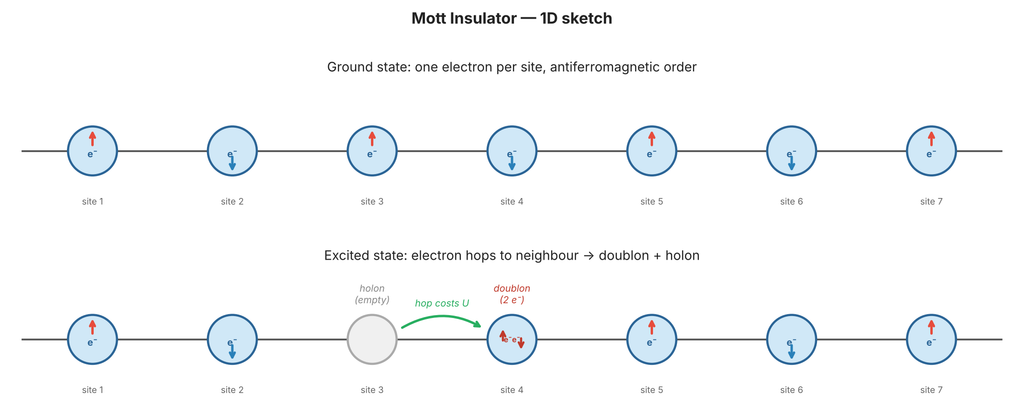
While the heavy fermions are strongly correlated metals, where the strong interactions lead to the formation of heavy bands, the parent compound of the high-Tc superconductors, i.e. the non doped compound with the same structure, is a strongly correlated insulator, the Mott insulator. Here the Coulomb repulsion U between the electrons leads to the formation of a gap in the bandstructure, and a material, that by just counting the numbers of electrons should actually be a metal, is actually an insulator. This is illustrated in this 1D cartoon: